


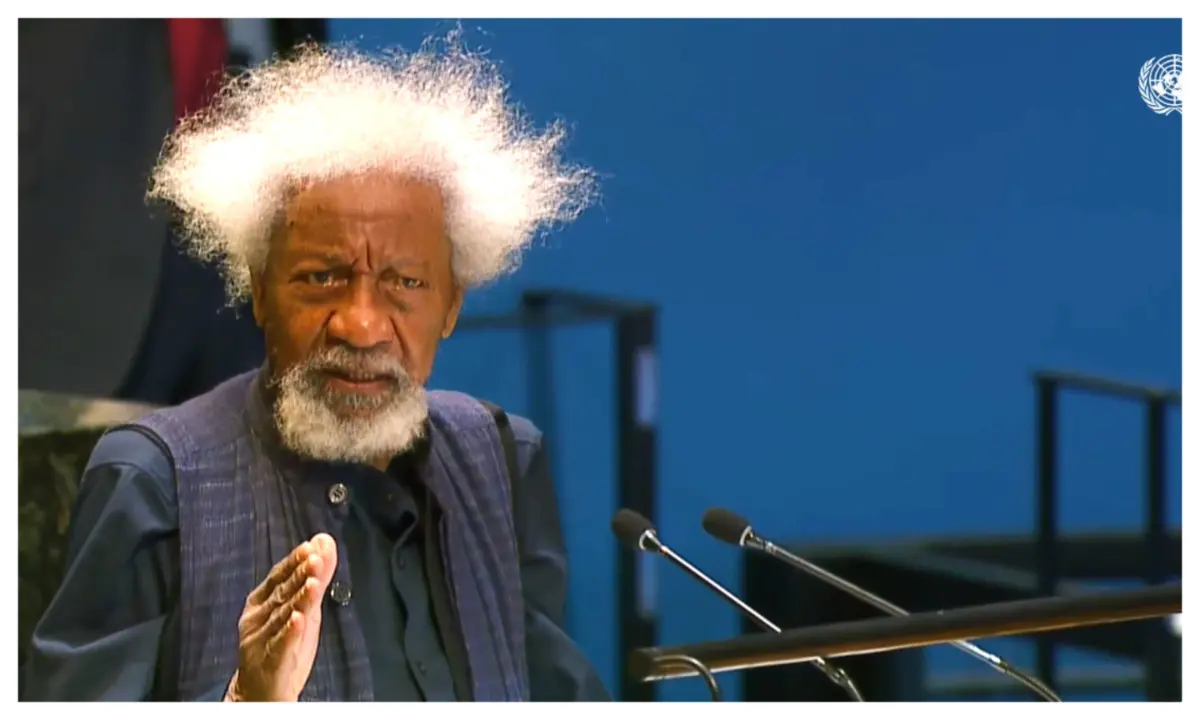
Nobel Laureate Wole Soyinka on Tuesday described the decade-long abduction of schoolgirls from Chibok town in Borno State, Nigeria, as a stark example of modern-day slavery.
Soyinka made this statement while addressing the United Nations General Assembly (UNGA) during a commemorative meeting on the 2025 International Day of Remembrance of the Victims of Slavery and the Transatlantic Slave Trade.
In April 2014, nearly 300 female students were abducted by Boko Haram from the Government Girls Secondary School in Chibok. While some have returned or been rescued, many remain unaccounted for.
Speaking at the UNGA session, which included President Philemon Yang and UN Secretary-General António Guterres, Soyinka emphasized that slavery is far from over, stating that “slave markets thrive all over the African continent.”
“Today, the new slavers simply wait for you and me to send our children to school, especially boarding schools,” he said. “They descend on them, carry them away, sequester them in the fastness of the forest, and then call on us to come and ransom them.”
“This happens almost on a daily basis,” Soyinka noted. “The name Chibok is familiar to all of you, but you have no idea how many Chiboks there are, especially in the West African subregion.”
The 90-year-old playwright, while referencing the portrayal of slavery in the 2012 film Django Unchained, stated that “Any human being owned by another is a slave, (or) is enslaved.”
“We can only imagine what kind of enslavement the girls of Chibok, of Dapchi (where Boko Haram kidnapped 110 schoolgirls in 2018), have been undergoing since 300 pupils were removed from their school in Nigeria,” Soyinka pondered.
“This is a blood on universal conscience, and events like that demand a constant alertness and acceptance of a phenomenon of which the entire globe should be ashamed since it’s gone on for over half a millennium, especially in a quantitative, commercial manner.”
Soyinka described slavery as a violation of humanity, stressing that its essence lies in the deprivation of individuals, races, communities, and nations of their right to self-determination.
However, he cautioned that unless the world adopts a comprehensive and egalitarian approach to addressing slavery, “it’s going to be with us for a very long time.”
Soyinka opposed material reparations for victims, saying that although “it is impossible to quantify the appropriate reparation for such a global atrocity, we can tackle it symbolically, so that it gives further meaning to the ambition of humanity to recover itself.”
In 2006, the United Nations General Assembly recognized that “the slave trade and slavery are among the worst violations of human rights in the history of humanity.”
The assembly designated March 25, 2007, as the International Day for the Commemoration of the Two-Hundredth Anniversary of the Abolition of the Transatlantic Slave Trade.
Following a resolution, the annual observance of the International Day of Remembrance of the Victims of Slavery and the Transatlantic Slave Trade began on March 25, 2008.