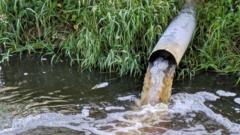
Recent research indicates that a vast majority of sewage spills into English waterways over the past two years likely violated legal standards without facing repercussions. Although national law prohibits the release of raw sewage during typical weather, the Environment Agency has historically lacked a precise definition of what constitutes such conditions.
Campaigner Prof. Peter Hammond successfully obtained confidential court documentation that clarified the threshold for heavy rain. His subsequent analysis of data from over 350 overflow outlets revealed that approximately 86% of spill hours occurred during periods lacking heavy rainfall, suggesting these events were potentially unlawful. Prof. Hammond criticized both the water companies for exploiting regulatory gaps and the Environment Agency for failing to provide adequate oversight.
The Environment Agency and Water UK have disputed these findings, noting that regional rainfall variances complicate enforcement and that they are committed to reducing discharge frequency. Nevertheless, independent bodies like the Office for Environmental Protection have previously criticized the agency for its inconsistent application of environmental laws. The Environment Agency maintains that it evaluates a broad range of evidence, including site-specific permit conditions, before pursuing criminal charges, though it declined to provide details on current enforcement actions regarding these potential violations.