




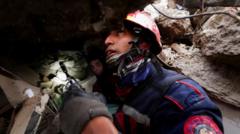
Rescue workers are continuing a desperate hunt for survivors trapped under debris following the twin earthquakes in Venezuela. While the 96-hour window for finding victims officially closed Sunday night, responders are maintaining a rigorous search effort. At least 1,450 people have died, a figure expected to rise as operations proceed.
UK International Search and Rescue (UK ISAR) coordinator Lee Ivory noted that crews are as committed now as they were on the first day. Specialized search dogs remain a vital tool, capable of detecting human scents up to 10 meters beneath rubble. These canines signal potential survivors with loud barking after being trained using scent-imprinted toys.
Sound detection technology is also employed, with rescuers listening for scratching or tapping on concrete. Advanced acoustic devices allow teams to pick up faint noises from deep within damaged structures. Additionally, technical search cameras on long poles enable teams to peer into tight crevices, while some models allow for direct communication with the trapped.
Thermal imaging helps detect body heat through certain walls, and UN officials are deploying miniature drones to scan difficult areas. For extraction, crews utilize a variety of heavy machinery, including bulldozers and cranes, alongside smaller tools like angle grinders and saws to breach concrete and furniture, allowing local and international teams to clear paths to those in need.