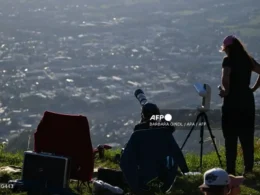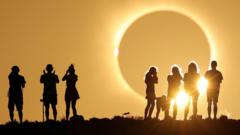
A spectacular solar eclipse, the most significant in nearly three decades, captivated millions of observers across the UK and Europe. In the UK, viewers experienced a partial eclipse that reached its peak shortly after 19:00 BST, with the Moon obscuring over 90% of the Sun. While the UK saw a partial eclipse, residents in parts of Iceland, Greenland, and Spain were fortunate enough to witness a total solar eclipse, where the Moon fully blocked the Sun.
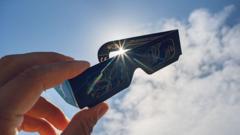
The celestial event traced a path starting from northern Siberia, crossing the Arctic Ocean, and moving south towards the UK and beyond. Despite a shortage of professional solar eclipse glasses, many people improvised with household items like colanders and cereal boxes to safely observe the event. Clear skies over central and southern England provided excellent viewing conditions, while those in Scotland and Northern Ireland navigated cloudier weather.
For those in the path of totality, such as in Spain, the event offered a rare glimpse of the Sun’s corona and pink prominences. This phenomenon is a result of a unique cosmic coincidence, where the Sun and Moon appear the same size in our sky due to their relative distances. Although the UK will not see another total eclipse until 2090, eclipse enthusiasts can look forward to a series of total eclipses globally between 2026 and 2028.