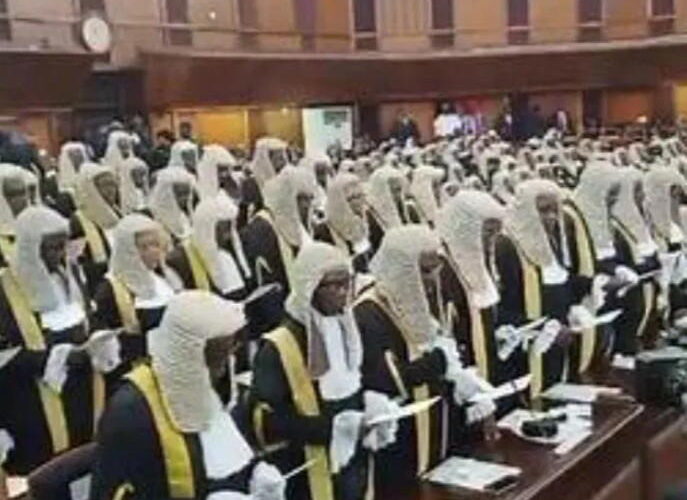
A recent Court of Appeal decision has reignited discussions regarding judicial integrity after the court overturned a Federal High Court ruling that previously ordered the deregistration of the African Democratic Congress and four other political parties. The appellate court, led by Justice Abba Mohammed, not only nullified the earlier judgment by Justice Peter Lifu but also labeled the trial judge’s actions as judicial impertinence and rascality.
Justice Lifu had directed the Independent National Electoral Commission to deregister these parties on June 15, 2026, despite a standing order from the appellate court to stay proceedings. The Court of Appeal concluded that the suit was fundamentally flawed because the National Forum of Former Legislators lacked the legal standing to initiate such an action. The court further highlighted that the trial judge ignored existing evidence and failed to operate within his constitutional authority.
Legal professionals and civil society representatives are now calling for the National Judicial Council to address such breaches of procedure. Experts argue that defiance of superior court orders undermines the entire legal hierarchy and erodes public trust in the judiciary. High-profile cases such as those involving governors Caleb Mutfwang and Abba Kabir Yusuf, as well as the historical Amaechi vs. INEC matter, are frequently cited as examples where the Supreme Court had to correct lower court errors to protect democratic processes and constitutional rights.
Advocates including Idris Faro, Toluwa Odekhe, and Patrick Onoja emphasized that judges must prioritize constitutional interpretation and respect for appellate hierarchy. They suggest that the National Judicial Council should take disciplinary action against judges who purposefully disregard stay orders, moving beyond mere verbal criticism to restore institutional credibility.