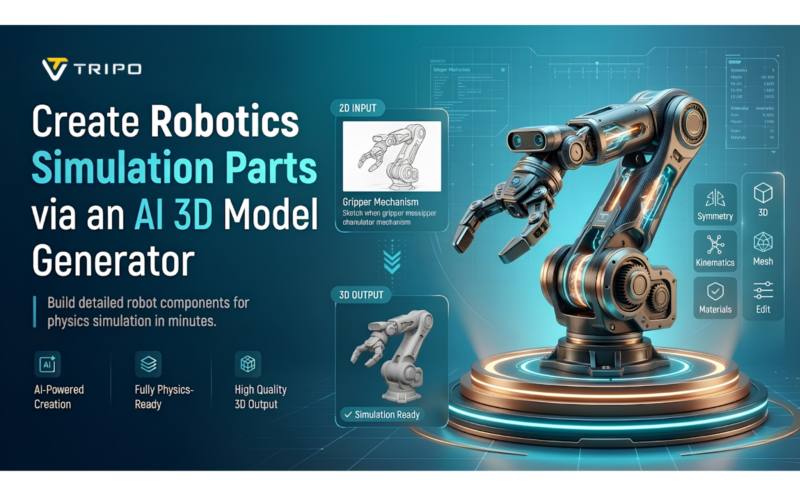
Precise digital components are vital for the reliability of robotics simulations. High-quality parts improve motion accuracy, collision detection, and overall engineering validation. Traditionally, crafting 3D models demands specialized skills and significant time. Tripo 3D addresses these challenges by automating workflows, allowing engineers to transform sketches or concepts into functional assets rapidly while maintaining structural integrity.
Reliable 3D geometry is fundamental for realistic virtual testing. Detailed components allow engineers to analyze motion and detect collisions with confidence. By validating designs before physical production, teams can mitigate risks and minimize development costs. Tripo 3D facilitates this by providing consistent assets that integrate seamlessly into various robotics development pipelines.
Modern engineering teams benefit from AI tools that convert text prompts or reference images into usable 3D models. This automation reduces manual modeling tasks, accelerates project timelines, and supports frequent design iterations. With Tripo 3D, engineers can generate assets featuring organized topology and high-resolution textures, ensuring compatibility with standard simulation software.
When designing components, mechanical accuracy and functional requirements remain priority. Clean mesh structures are essential for proper joint articulation and simulation performance. By balancing visual quality with computational efficiency, tools like Tripo 3D streamline the production of parts ranging from base frames to complex manipulators. Ultimately, AI-driven workflows empower developers to focus on testing and optimization, fostering faster innovation in the robotics industry.