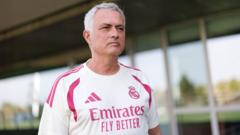
Thirteen years after his departure as one of the world’s most prominent managers, Jose Mourinho has returned to the Bernabeu. The 63-year-old takes over a Real Madrid side currently struggling through two consecutive trophy-less seasons. His appointment prompts significant debate regarding whether the veteran coach can recapture his previous success or if his best managerial years have already passed.
Since leaving Madrid in 2013, Mourinho has experienced mixed results across several clubs, including Manchester United, Tottenham, and Roma. Spanish football analyst Eduardo Alvarez suggests that president Florentino Perez is banking on a scenario similar to Carlo Ancelotti’s second stint, which eventually yielded Champions League success. Alvarez notes that Mourinho’s current management style leans more toward player relationships rather than intense tactical rigidity, a fit he believes suits the current squad dynamics.
However, former club president Ramon Calderon warns that Mourinho must evolve to succeed. He stresses that the manager needs to win over players through persuasion rather than confrontation. Historically, Mourinho’s tenures have been marked by friction with media and staff, and experts like Portuguese journalist Duarte Monteiro argue that his core personality remains unchanged while the football landscape has moved on.
Former Chelsea defender Robert Huth highlights that while Mourinho’s methods can be blunt, his capacity to unify a dressing room is unparalleled. Managing current stars like Kylian Mbappe, Vinicius Jr, and Jude Bellingham will require a delicate balance. Ultimately, while Mourinho maintains vast tactical knowledge, the challenge lies in his ability to adapt to a modern generation of players who may not respond to his traditional, uncompromising leadership style.