




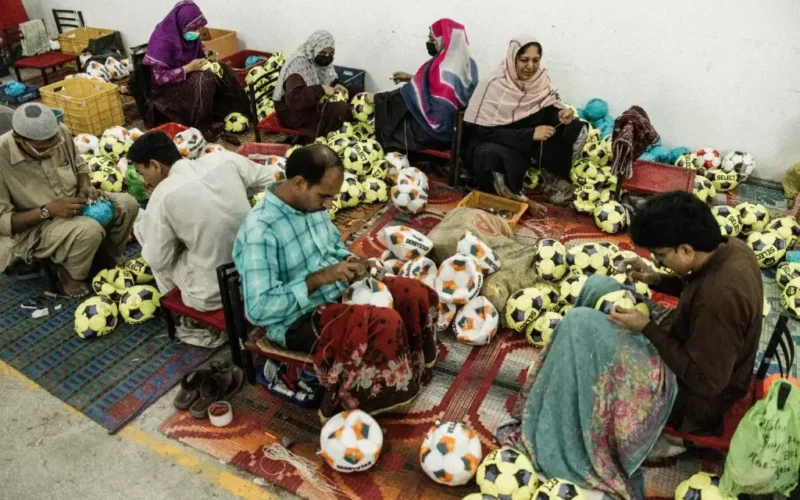
Sialkot, located in Pakistan’s Punjab province, serves as the primary engine for the global football industry. This city accounts for approximately 70% of the world’s annual football output, a tradition that began over a century ago when residents repaired balls as a hobby. Today, this craft has evolved into a massive manufacturing sector, with about 40 million units exported from Pakistan every year.
The city has maintained a long-standing relationship with FIFA, having produced the official World Cup match ball for over four decades, starting in 1982. Looking toward the 2026 World Cup, the manufacturer Forward Sports has created the official Trionda ball for Adidas, marking their largest production volume in history. Photographer Stefan Bohrer, who observed the process, noted that the factories output nearly 300,000 balls daily.
Despite the high volume, the manufacturing process remains labor-intensive. Skilled workers manually stitch panels and apply branding, with each stitcher averaging about four balls per day. The creation of a professional match ball is a rigorous endeavor that can take up to four years, involving intensive research into thermal technologies, durability, and strict performance metrics mandated by FIFA.
While World Cup match balls gain the most attention, they make up a small fraction of the local output. Most of Sialkot’s production consists of training balls for schools and amateur clubs, alongside custom branding for various corporate clients. Although global competition, particularly from China, continues to challenge the industry, Sialkot remains an essential pillar of the global game.