




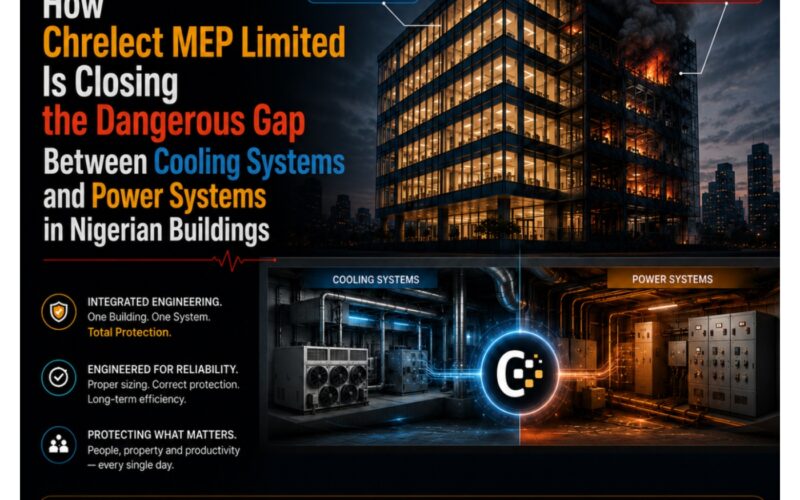
Many buildings across Nigeria suffer from recurring mechanical and electrical failures because their climate control and power infrastructure are treated as unrelated components. Whether it is an office struggling with inconsistent temperatures or a commercial facility experiencing frequent power trips, these issues often stem from a lack of coordination during the design phase. Cooling systems, particularly in industrial settings, represent the highest energy demand, yet they are frequently installed without proper integration with the building’s electrical capacity.
When HVAC systems are not synchronized with electrical designs, the resulting issues go beyond simple discomfort. Inadequate cable sizing, poor panel distribution, and weak protection circuits can lead to overheating and, in extreme cases, electrical fires. Chrelect MEP Limited addresses this by managing mechanical and electrical engineering as a single, unified process. By calculating cooling and power loads concurrently, they ensure that equipment is sized, installed, and commissioned to function as a cohesive unit.
Evelyn, an SBD Executive at Chrelect MEP, notes that many cooling malfunctions are actually electrical issues, while perceived wiring problems often originate from unplanned cooling demands. The company mitigates these risks through a five-stage approach: integrated design, equipment selection, professional installation, rigorous commissioning, and proactive maintenance. This strategy prevents the efficiency losses and safety hazards that typically plague properties where these systems operate in silos. For Nigerian facility owners, this integrated engineering approach provides a path toward safer, more reliable building operations that are resilient against the demands of the local power grid.