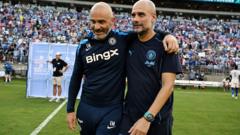
Pep Guardiola is leaving an enduring tactical mark on English football as he concludes his decade-long tenure at Manchester City.
His influence transcends individual clubs, affecting the sport from grassroots levels up to the elite tier. While his philosophy is rooted in clear principles, he has proven equally capable of evolving his strategies based on the personnel available.
A primary transformation arrived with his insistence on ball-playing goalkeepers. Initially questioned for replacing Joe Hart, Guardiola’s preference for keepers comfortable with the ball became a league-wide standard, influencing moves by clubs like Arsenal, Chelsea, and Manchester United. Yet, as tactical trends shift toward high pressing, Guardiola has recently pivoted, utilizing keepers like Gianluigi Donnarumma for their shot-stopping prowess rather than pure passing ability.
Guardiola’s ability to innovate during personnel crises remains a hallmark of his career. When faced with fullback injuries in 2018, he famously deployed inverted fullbacks, instructing players like Oleksandr Zinchenko to tuck into midfield.
This method provided structural security and improved build-up play, a strategy subsequently adopted by proteges like Mikel Arteta and other admirers like Ange Postecoglou. He further pushed tactical boundaries by fielding traditional center-backs in wide positions to reinforce his defensive structure.
His unwavering commitment to possession has also redefined expectations. Under his guidance, City rarely averaged below 60 percent possession, setting a benchmark that coaches across the league—from Brighton to Arsenal—now strive to emulate.
Although many peers have struggled to replicate his success due to disparities in player quality or an inability to keep pace with his rapid tactical shifts, Guardiola’s legacy as a transformative force in a league once defined by direct, high-intensity play is undisputed.