




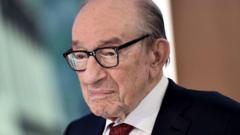
Alan Greenspan, the former head of the US Federal Reserve, has died at the age of 100. His spouse, NBC News correspondent Andrea Mitchell, confirmed that he passed away due to complications from Parkinson’s disease. Serving as Fed chair from 1987 to 2006, Greenspan oversaw the longest period of sustained American economic expansion in modern history.
Born in New York City in 1926, Greenspan initially pursued a career as a professional clarinetist before shifting his focus to economics. After studying at New York University, he emerged as a strong advocate for free-market principles, heavily influenced by philosopher Ayn Rand. His career in public service included leadership roles under various administrations, starting with the Council of Economic Advisers under Richard Nixon and Gerald Ford, before Ronald Reagan appointed him to lead the Federal Reserve in 1987.
Throughout his tenure, Greenspan was often viewed as a financial oracle. He navigated several major economic hurdles, including the 1987 stock market crash and the dot-com bubble. However, his legacy remains complex. Critics frequently pointed to his preference for low interest rates and limited regulation as contributing factors to the 2008 sub-prime mortgage crisis. By 2008, Greenspan acknowledged to Congress that his faith in the banking industry’s ability to self-regulate had been misplaced.
Despite these controversies, Greenspan was widely recognized as a primary architect of the modern American financial system. Over his lengthy career, he received the Presidential Medal of Freedom and an honorary knighthood. He continued to offer economic commentary well into his later years, remaining a prominent voice in global financial discussions until his death.