




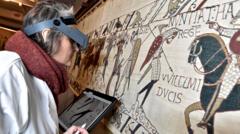
The Bayeux Tapestry serves as a detailed historical record, documenting the intense power struggles, betrayals, and conflicts of 11th-century England. This 70-meter embroidered artifact provides a visual narrative of the Norman conquest and the definitive Battle of Hastings in 1066. Dr. David Musgrove, an expert in the field, highlights five key scenes that define this ancient chronicle.
The narrative begins in the mid-1060s, showing Harold, Earl of England, forming an alliance with William, Duke of Normandy. Initially, the embroidery portrays Harold as an honorable warrior receiving armaments from the Duke. However, a significant turning point occurs when Harold allegedly swears an oath of allegiance to William over holy relics. Dr. Musgrove notes that the artwork captures Harold looking conflicted during this scene, marking his transition from a heroic figure to a treacherous one in the eyes of the Normans.
Following the death of Edward the Confessor in 1066, Harold’s decision to claim the English throne is treated as a betrayal of his oath. The tapestry depicts Halley’s Comet as a celestial omen of impending disaster. This tension culminates at the Battle of Hastings. The final famous scene features Harold’s death, reportedly by an arrow to the eye, though historians debate if this detail was added in later restorations or if it accurately represents the final moments of his life.
The tapestry acts as a dramatic record of events that forever altered the course of British history. After nearly a millennium, the piece is set to be exhibited at the British Museum between September 2026 and July 2027.